Geometry of Triangles and Quadrilaterals
Updated August 2025
This lesson covers the essential definitions and properties of triangles and special quadrilaterals for the TMUA. You will learn to derive and apply the characteristics of shapes such as the rhombus, kite, and trapezium. Mastery of these geometric facts is vital for solving complex coordinate and reasoning problems on Paper 1.
Plane figures are classified by their side and angle properties. For the TMUA, you must move beyond simple recognition to deriving properties using symmetry, parallel line theorems, and congruence.
Classification and Properties of Triangles
Triangles are the foundational building blocks of plane geometry. For the TMUA, you must be precise in your use of language and notation. Triangles are classified either by their side lengths or by their internal angles.
-
Equilateral Triangles: All three sides are equal in length, and all three internal angles are . These shapes have three lines of reflectional symmetry and rotational symmetry of order 3.
-
Isosceles Triangles: At least two sides are equal in length. The angles opposite these sides (the base angles) are also equal. This symmetry implies that the altitude from the vertex between the equal sides bisects the base at a right angle.
-
Scalene Triangles: No sides or angles are equal.
Triangles are also defined by their largest angle. A right-angled triangle contains one angle, satisfying Pythagoras' Theorem. An acute triangle has all angles less than , and an obtuse triangle has one angle greater than . Two critical theorems always apply:
- The sum of the interior angles of any triangle is .
- The Exterior Angle Theorem: The exterior angle at any vertex of a triangle is equal to the sum of the two opposite interior angles.
Special Types of Quadrilaterals
Quadrilaterals are four sided polygons. The sum of their interior angles is always . The TMUA requires you to know the inclusive definitions of these shapes, where a more specific shape inherits the properties of a more general one.
The Parallelogram
A parallelogram is defined as a quadrilateral with two pairs of parallel sides. From this definition, we can derive several properties using the properties of parallel lines (alternate and corresponding angles):
- Opposite sides are equal in length.
- Opposite interior angles are equal.
- Consecutive angles are supplementary (sum to ).
- The diagonals bisect each other (the point of intersection is the midpoint of both diagonals).
The Rectangle and Rhombus
A rectangle is a special type of parallelogram that contains four right angles. Because it is a parallelogram, its opposite sides are equal and its diagonals bisect each other. Additionally, the diagonals of a rectangle are equal in length.
A rhombus is a special type of parallelogram with four equal sides. Its unique properties, derived from its symmetry, include:
- Diagonals bisect each other at right angles ().
- Diagonals bisect the interior angles of the rhombus.
The Square
A square is the most regular quadrilateral. It is simultaneously a rectangle and a rhombus. It possesses four right angles, four equal sides, and diagonals that are equal, perpendicular, and bisect each other.
The Trapezium
A trapezium (or trapezoid) is a quadrilateral with at least one pair of parallel sides. An isosceles trapezium is a special case where the non-parallel sides are equal in length, resulting in equal base angles and equal diagonals.
The Kite
A kite is defined by two pairs of equal adjacent sides. Unlike a parallelogram, its opposite sides are not equal. Its properties include:
- One pair of opposite angles (the ones between the sides of different lengths) is equal.
- One diagonal (the main axis of symmetry) bisects the other diagonal at a right angle.
- One diagonal bisects the internal angles at its vertices.
Deriving Properties Using Congruence
Many geometric properties are derived by dividing a figure into triangles and proving they are congruent. For example, to prove that the diagonals of a parallelogram bisect each other, we can use the Angle-Side-Angle (ASA) rule on the two triangles formed by the diagonals and a pair of opposite sides. Since the sides are parallel, alternate interior angles are equal, and since opposite sides of a parallelogram are equal, the triangles must be congruent. This leads directly to the conclusion that the diagonal segments are of equal length.
General Polygons
You must be able to generalise these rules to any sided polygon:
- Sum of interior angles: .
- Sum of exterior angles: for any convex polygon.
- For a regular polygon, each interior angle is and each exterior angle is .
Key takeaways
- Opposite angles of a parallelogram are equal, and consecutive angles sum to .
- Diagonals of a rhombus bisect each other at right angles and also bisect the corner angles.
- A square is defined as both a rectangle and a rhombus, inheriting all properties of both.
- The exterior angle of a triangle is exactly equal to the sum of the two opposite interior angles.
- The sum of interior angles for any sided polygon is .
When a problem involves an unfamiliar quadrilateral, try drawing a diagonal to split the shape into two triangles. You can then apply triangle properties or congruence rules to find missing angles or side lengths.
Do not assume a parallelogram has equal diagonals unless you are told it is a rectangle. Similarly, do not assume diagonals are perpendicular unless the shape is a rhombus, a square, or a kite.
The inclusive hierarchy of quadrilaterals is a common source of logic questions in TMUA Paper 2. Remember that the set of all squares is a subset of the set of all rectangles, which is itself a subset of the set of all parallelograms.
Worked Examples
Practice Questions
I length of = length of
II The diagonal intersects the diagonal at right angles
III
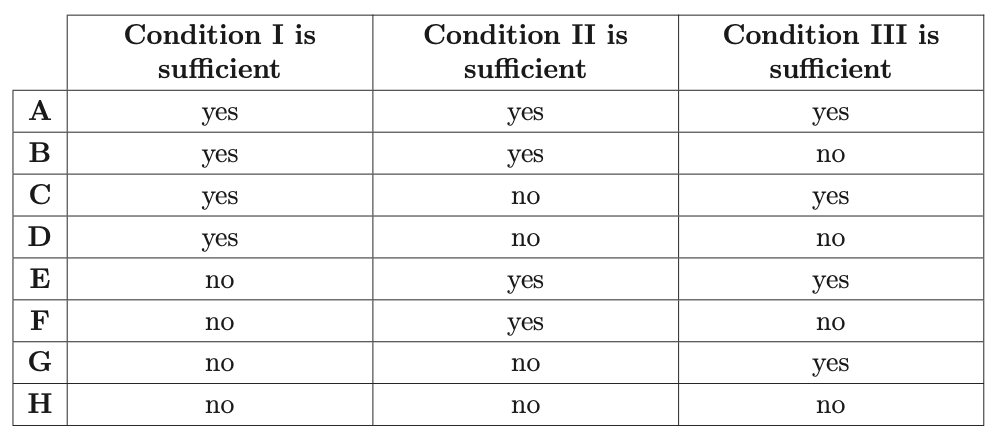
Which of these conditions is/are individually sufficient for the parallelogram to be a square?
Frequently asked questions
Is a square considered a trapezium?
Yes. Under the inclusive definition, a trapezium is a quadrilateral with at least one pair of parallel sides. Since a square has two pairs of parallel sides, it satisfies the definition of a trapezium.
What is the difference between a rhombus and a kite?
In a kite, two pairs of adjacent sides are equal. In a rhombus, all four sides are equal. Therefore, every rhombus is a kite, but not every kite is a rhombus.
How do you find the sum of exterior angles of a polygon?
For any convex polygon, the sum of the exterior angles is always , regardless of the number of sides .
Do the diagonals of a kite bisect each other?
No. In a kite, only one of the diagonals is bisected by the other. The diagonal that acts as the line of symmetry bisects the other diagonal at a right angle.