Triangle Congruence Criteria for the TMUA
Updated August 2025
Congruence is a fundamental concept in Euclidean geometry where two shapes are identical in size and shape. For the TMUA, you must precisely apply the SSS, SAS, ASA, and RHS criteria to prove triangles are identical, a skill essential for solving complex geometric proofs and coordinate geometry problems.
Two triangles are congruent if one can be transformed into the other via a sequence of rigid motions (translation, rotation, and reflection). This is proven if they satisfy one of four criteria: SSS (Side-Side-Side), SAS (Side-Angle-Side), ASA (Angle-Side-Angle), or RHS (Right-angle, Hypotenuse, Side).
Understanding Geometric Congruence
In geometry, two figures are described as congruent if they are exactly the same shape and size. If two triangles are congruent, all their corresponding side lengths are equal and all their corresponding interior angles are equal. While a triangle has six primary measurements (three sides and three angles), you do not need to know all six to prove congruence. Instead, specific combinations of three measurements are sufficient to 'lock' the triangle into a unique shape.
The Four Criteria for Congruence
You must be able to recognise and use the following four criteria in TMUA questions:
-
SSS (Side-Side-Side): If the three sides of one triangle are equal to the three sides of another triangle, the triangles are congruent. This is because a triangle with fixed side lengths has no 'flexibility', the interior angles are entirely determined by the side lengths via the Cosine Rule, .
-
SAS (Side-Angle-Side): If two sides and the included angle of one triangle are equal to two sides and the included angle of another triangle, the triangles are congruent. The term 'included' is vital: the angle must be the one located between the two known sides. If the angle is not between the sides, the triangle is not necessarily unique (see the 'SSA' caution below).
-
ASA (Angle-Side-Angle): If two angles and the side between them are equal to the corresponding parts of another triangle, they are congruent. Note that since the angles of a triangle always sum to , knowing any two angles automatically gives the third. Therefore, AAS (Angle-Angle-Side) is also a valid proof of congruence, provided the side is in the same relative position in both triangles.
-
RHS (Right-angle, Hypotenuse, Side): This is a special case for right-angled triangles. If two right-angled triangles have equal hypotenuses and one other equal side, they are congruent. According to Pythagoras' Theorem, , if the hypotenuse and one side are fixed, the third side must also be equal, effectively satisfying the SSS criterion.
Identifying Non-Congruent Triangles
It is equally important to know which combinations do not prove congruence:
- AAA (Angle-Angle-Angle): Having three equal angles proves that triangles are similar (the same shape), but not necessarily congruent (the same size). One triangle could be a scaled-up version of the other.
- SSA (Side-Side-Angle): If you know two sides and an angle that is not included between them, there may be two different possible triangles. This is known as the 'ambiguous case' of the Sine Rule, where the unknown side can take two different lengths while keeping the given side-side-angle measurements constant.
Worked Example: Applying Criteria in Proofs
Consider a circle with centre . Let be a chord, and let be the midpoint of . Prove that the line is perpendicular to .
- Draw the radii and .
- In triangles and , we have:
- (both are radii of the same circle).
- (given that is the midpoint).
- (shared common side).
- Therefore, by the SSS criterion.
- Because the triangles are congruent, the corresponding angles and must be equal.
- Since is a straight line, .
- As the angles are equal and sum to , each must be , proving that is perpendicular to .
Key takeaways
- Congruence means identical in size and shape, requiring all corresponding sides and angles to be equal.
- SSS, SAS, ASA/AAS, and RHS are the only valid criteria for proving triangle congruence.
- The SAS criterion strictly requires the angle to be the 'included angle' between the two known sides.
- AAA proves similarity but not congruence, while SSA is ambiguous and invalid for proving congruence.
When tackling a geometry problem, look for shared sides or radii in circles, as these often provide the 'hidden' equal sides needed to satisfy SSS or SAS.
Never assume congruence based on the 'SSA' condition. If the given angle is not between the two given sides, there are often two different triangles that could be formed, meaning the triangles are not necessarily congruent.
Congruence is a subset of similarity. While similarity requires a constant ratio between sides (a scale factor ), congruence is the specific case where the scale factor .
Worked Examples
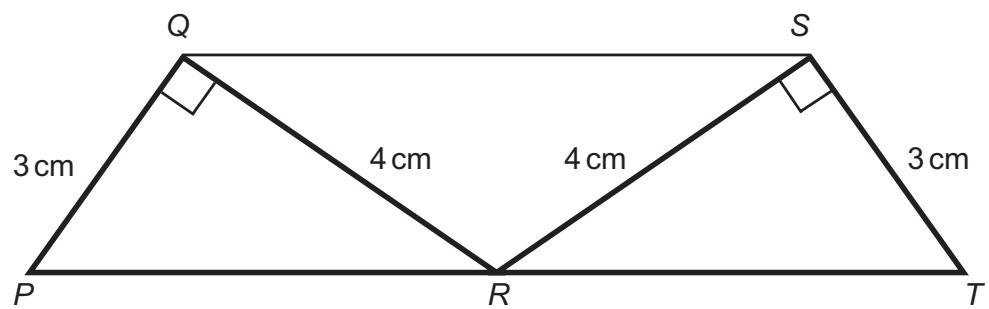
[diagram not to scale]
PQ = TS = 3 cm
QR = SR = 4 cm
PRT is a straight line.
What is the length, in cm, of QS?
Practice Questions
Frequently asked questions
Is AAS the same as ASA?
Essentially, yes. Because angles in a triangle sum to , knowing two angles () and any side () allows you to calculate all angles. As long as the side corresponds in position between the two triangles, they are congruent.
Why does RHS only apply to right-angled triangles?
RHS is a specific shortcut derived from Pythagoras' Theorem. In non-right-angled triangles, knowing the longest side and one other side does not fix the third side unless the included angle is also known.
How does the TMUA test this topic?
The TMUA often uses congruence as a hidden step in larger problems. You might need to prove two triangles are congruent to show that two line segments are equal in length or to justify that a shape has certain symmetries.