Dividing Quantities in Ratios for the TMUA
Updated August 2025
This lesson explains how to divide a total amount into specific proportions and how to express the relationship between two separated quantities as a ratio. Mastering these calculations is essential for TMUA problems involving shared resources, geometric scaling, and chemical mixtures. It covers the unitary method and unit conversion requirements.
To share a quantity in the ratio , calculate the value of one 'part' by dividing the total by the sum of the ratio terms , then multiply this value by and respectively.
Dividing a Quantity in a Given Ratio
When a quantity is divided into a given part:part ratio, such as , the process involves sharing the total amount into a specific number of equal portions. To perform this calculation accurately, follow this three step method:
-
Find the value of one part: Add the terms of the ratio together to find the total number of parts. Divide the total quantity by this sum to determine the value of a single part.
-
Calculate the value of each share: Multiply the value of one part by the first term of the ratio to find the first portion. Then, multiply the value of one part by the second term to find the second portion.
-
Verify the result: Ensure that the calculated portions add up to the original quantity . This check helps to identify any arithmetic errors.
Worked Example: Dividing a Monetary Amount
Consider the task of dividing in the ratio .
First, we find the total number of parts by adding the terms of the ratio: parts.
Next, we calculate the value of a single part: per part.
Now, we multiply this unit value by each term in the ratio to find the individual shares: For the 11 parts: For the 7 parts:
Finally, we check the total: . The calculation is correct.
Expressing a Division as a Ratio
In some TMUA problems, you will be given the sizes of two parts and asked to express their relationship as a ratio. To do this, you must adhere to two primary rules:
-
Unit Consistency: Both parts must be expressed in the same units before the ratio is formed. If the units differ, convert the larger unit to the smaller unit to avoid unnecessary decimals.
-
Ratio Notation: Once the units are identical, write the values in the form . It is standard practice to simplify the ratio by dividing both terms by their highest common factor (HCF).
Worked Example: Comparing Lengths of Ribbon
A piece of ribbon is divided into two pieces, A and B. Piece A is cm long and piece B is m long. We wish to find the ratio of the lengths of A and B.
First, we must equalise the units. Since A is in centimetres, we convert B to centimetres: m cm.
Now we can write the ratio of the lengths A : B using these values:
To provide the answer in its simplest integer form, we divide both sides by their highest common factor. Both numbers are divisible by :
The simplified ratio of A : B is .
Key takeaways
- The total number of parts is always the sum of all terms in the ratio.
- Before forming or using a ratio, ensure all quantities are in identical units.
- The value of one part is found by dividing the total quantity by the total number of parts.
- A ratio represents the fractions and of the whole.
Always perform the final check by adding your calculated parts together. If they do not sum to the original total, you have likely used the wrong divisor in step one.
A frequent mistake is dividing the total quantity by only one of the ratio terms instead of their sum. Remember that the ratio represents parts of a whole, so the divisor must be the total number of parts.
This topic connects ratio directly to linear functions. If a quantity is divided such that the ratio of two parts is , the relationship can be expressed as the linear equation . Understanding this helps when variables are used instead of fixed numbers.
Worked Examples
Practice Questions
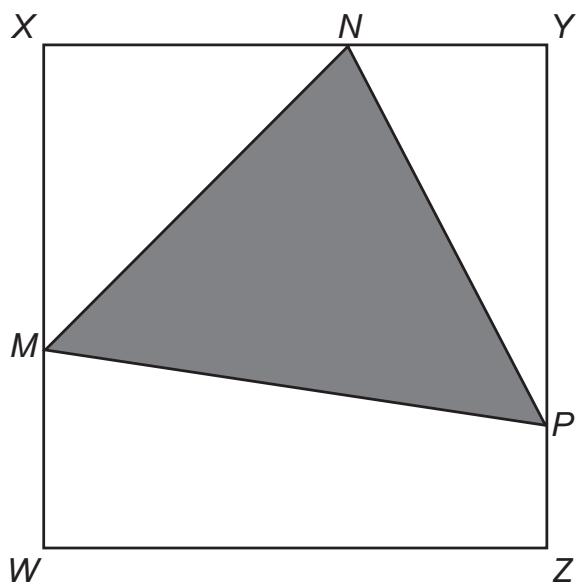
[diagram not to scale]
WXYZ is a square of side length 1.
What is the area of triangle MNP?
Frequently asked questions
What should I do if the ratio has more than two parts?
The method remains the same: add all terms together to find the total number of parts, divide the total quantity by this sum to find the value of one part, and then multiply by each individual term.
Can I use decimals within a ratio?
While ratios can involve decimals, TMUA answers are typically expected in the simplest integer form. Multiply both sides by a power of 10 to remove decimals, then simplify as usual.
How do I know which unit to convert to when they are different?
It is generally easier to convert to the smaller unit (for example, converting metres to centimetres) to work with whole numbers rather than fractions or decimals.