Ratio Notation for the TMUA
Updated August 2025
Ratio notation is a fundamental method for comparing quantities of the same kind. For the TMUA, you must be able to express relationships between parts and wholes, simplify ratios into integer forms, and ensure unit consistency. This topic serves as the building block for more complex proportion and scaling problems.
A ratio expresses the relative sizes of two or more values. To be mathematically comparable, the quantities must be in the same units, allowing the ratio to be simplified by multiplying or dividing all parts by the same positive constant.
Understanding Ratio Notation
Ratio notation is used to compare the magnitudes of different quantities. If a collection, such as a bag of sweets, contains red items and yellow items, the relationship is expressed as the ratio . This is read as to . It is important to distinguish between part to part ratios (comparing red to yellow) and part to whole ratios (comparing red to the total number of items).
Simplifying Ratios
A ratio remains unchanged if both sides are multiplied or divided by the same positive number. This is identical to the process of finding equivalent fractions. In many TMUA problems, you will be required to convert a ratio containing decimals or fractions into a ratio of integers (whole numbers).
Worked Example: Simplifying to Integers
A mixture consists of of flour and of sugar. What is the ratio of flour to sugar, by weight, expressed as a ratio of integers?
- Write the initial ratio: .
- To remove the decimals, multiply both sides by .
- results in .
Comparing Quantities and Unit Consistency
To compare quantities using ratios, the units must be identical. If the quantities are provided in different units, you must convert them to a common unit (usually the smaller of the two) before writing the ratio. A ratio formed from quantities with different units is not mathematically valid until the units are unified.
Worked Example: Ratio with Unit Conversion
A mixture contains of flour and of sugar. What is the ratio of flour to sugar, by weight, in its lowest integer terms?
- Identify the units: we have kilograms and grams.
- Convert to a common unit: .
- Write the ratio in grams: .
- Simplify by dividing by a common factor. Dividing both by : gives .
Ratios of Parts to Totals
Some problems require comparing a single component to the sum of all components. It is vital to read the question carefully to determine if the denominator (the second part of the ratio) should be a specific part or the total.
Worked Example: Part to Total Ratio
Jana has of red ribbon and of blue ribbon. What is the ratio of the length of red ribbon to the total length of blue and red ribbon?
- Calculate the total length: .
- Identify the required parts: Red ribbon () and Total length ().
- Express as a ratio: .
Key takeaways
- A ratio only allows for direct comparison if and share the same units.
- Ratios can be simplified by dividing all terms by their Highest Common Factor (HCF).
- To eliminate decimals in a ratio, multiply all terms by a common multiple (often or ).
- Always distinguish between part to part ratios and part to total ratios as required by the context.
When dealing with ratios involving decimals, look for the smallest multiplier that turns all terms into integers. If you have , multiplying by to get is often faster than multiplying by and then simplifying.
A common error is forming a ratio using different units, such as being written as . Always convert to the same unit first to get , which simplifies to .
Ratios are dimensionless. Because they compare quantities of the same unit, the units effectively cancel out. This is why ratios are so versatile in geometry and physics for comparing scales, where the actual size doesn't matter as much as the relative proportion.
Worked Examples
Practice Questions
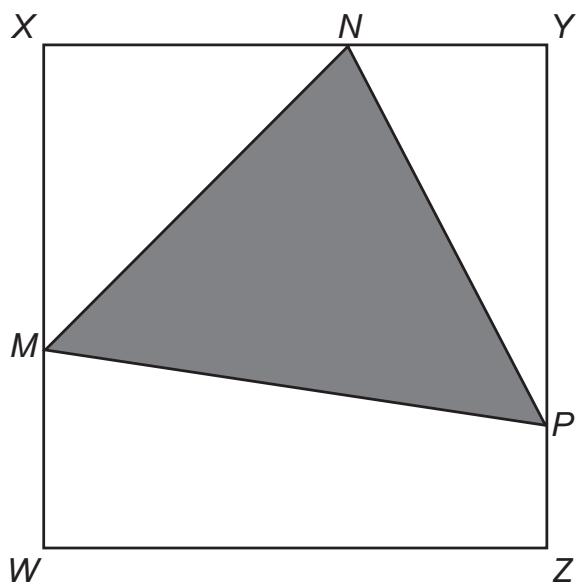
[diagram not to scale]
WXYZ is a square of side length 1.
What is the area of triangle MNP?
Frequently asked questions
Must ratios always be written in their simplest form?
In most exam contexts, including the TMUA, you should simplify a ratio to its lowest integer terms unless specified otherwise. This makes the relationship between quantities clearer and easier to use in further calculations.
Can a ratio have more than two parts?
Yes, ratios can compare three or more quantities, such as . The same rules apply: you can multiply or divide all parts by the same constant to simplify the ratio.
How do I convert a ratio with fractions into an integer ratio?
Multiply all parts of the ratio by the Least Common Multiple (LCM) of the denominators. For example, the ratio becomes after multiplying by .